Showing posts with label news. Show all posts

Saturday, August 21, 2010

Will Mars Appear As Big As The Moon?

In a word, no. Let me say that again: NO.

Every summer since 2003, an email has been circulating which claims that on the night of August 27th Mars will appear as big as the full moon. Of course, even the email itself admits, albeit in tiny print, that this will only be the case if Mars is view at 75-power magnification.

The truth is that in 2003, Mars and Earth were closer in their orbits than they had been in a long time, or will be in something like 60,000 years. That said, the difference between Mars' appearance in 2003 and, say, 2005 was extremely negligible.

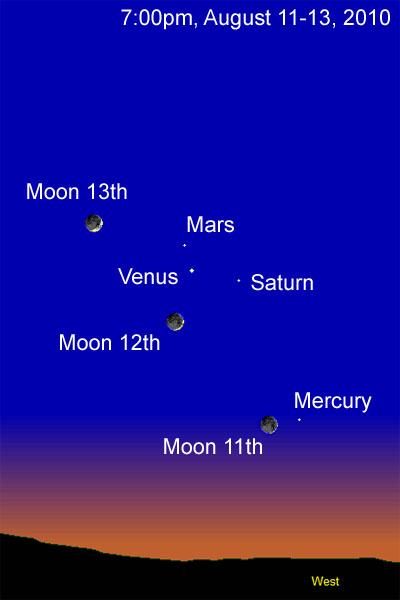
The good new? You can see Mars tonight in the night sky! In fact, if you time it right and the skies cooperate, you'll see Mercury, Saturn, Venus and Mars all once in the western sky at dusk. They'll all be gone by about 10 PM, so don't dally! (Oh, but also don't worry if it's overcast tonight; these planets will be all be visible together for the next week or so.)


Note: Even though you won't see the moon in those spots, since we're past those dates, you'll still the planets lined up like this through the end of the month. No telescope needed, so I don't want to hear any excuses!

Wednesday, May 6, 2009

Colbert Gets His Wish

As reported by NASA, Stephen Colbert will have his name on a piece of important space equipment. While it may not be a module of the International Space Station, it will be aboard ISS. Formerly known as T2, the Combined Operational Load-Bearing External Resistance Treadmill will provide astronauts will a much-needed exercise regime that will help keep them healthy in space. Way to go, COLBERT!

Thursday, March 5, 2009

Don't Let My Technical Issues Stop You...

...from finding out more about the launch of the Kepler spacecraft! NASA says that the launch window is 10:49 to 10:52 PM, with a second window at 11:13 to 11:16 PM ET. We'll be camping in the Everglades, so we will be on the lookout. (Hopefully Little Dudestronomer will be asleep by now.)
I meant to post more, but we're having some gigantic virus issues here at home, so you'll just have to wait to hear more from me. I'll be sure to update you when we get back from our little expedition and/or our computer will start up properly.

Tuesday, February 24, 2009

Sad News For NASA Mission

NASA's Orbiting Carbon Observatory launched from Vanderberg Air Force Base at 1:55 AM local time, but as it headed its orbital path intended to study Earth's atmosphere, the shroud (a hard casing that protected the instrument during launch) failed to separate. This caused the satellite to crash into the Pacific Ocean near Antarctica. This 8 year project had an estimated cost of $278 million. NASA's press release is available at this link.
It's always interesting to me that when a spacecraft launches/lands/arrives successfully, NASA releases very exciting headlines. See this release from January 2004, when Spirit arrived on Mars. But when a mission goes badly, they come up with the most boring headline ever, as if they would prefer that you skip right over it. If you read the link I posted above for this most recent press release, you'll see that it avoids colorful terms like "crash," or "ruined;" it simply "failed to reach orbit." However, this Reuters release isn't nearly as circumspect; look for phrases like "dooming the mission" and "botched satellite launch." In the end, I guess NASA is only human.
Also, if you're the kind of person who thinks NASA is a huge waste of taxpayers' dollars and this is just one of many examples of that, now's the time to post your rant in the comments section. If you disagree, please feel free to say so as well. (Let's keep it civil, please.)

R.I.P.
Orbiting Carbon Observatory

Saturday, February 21, 2009

More Questions and an Announcement

Bob in Goleta, CA asks: "What is happening with the rover today? What are the people in the space shuttle doing? What is the recent dust storm on Mars doing to the solar system?"
Great questions, Bob! I'm so glad you asked, because your timely questions bring me to my announcement: today is the official kick-off of my weekly news round up. In an effort to make sure you at least see a headline and know where to get more info on some of the top happenings of the week, I'm going to post a round up of all the cool stuff you might have accidentally missed. And I promise that this week's edition will answer your questions, Bob.
Let's start with the rovers. Spirit recently got a quick cleaning from a two recent dust storms that reduced the amount of dust on the solar panels significantly. Interestingly, when the rovers arrived, engineers from JPL were concerned that Mars' frequent and intense dust storms would cake the solar panels with dust and reduce their battery life; however, just the opposite has been true - the dust storms have repeatedly given the rovers new life as they've swept away some of the layers of dirt from the panels. Opportunity is also doing well; its right front wheel has had some issues for over three years, and recent diagnostic mobility drives have kept Opportunity and JPL engineers busy analyzing the degree of damage. Status reports for both rovers are updated weekly here.
In shuttle news, the launch of STS-119 (the next shuttle launch) has been deferred. Because of damage to a flow control valve that occurred during Endeavor's Nov. 2008 flight, NASA officials have decided that further investigation is needed before setting a launch date. STS-119 will carry a truss for the ISS as well as a new crew member to the space station. More info here. There are no current shuttle missions at this time.
In astronomical headlines, NASA's Fermi Gamma-ray Space Telescope (formerly known as GLAST) saw the largest gamma-ray burst ever recorded, and it saw it in hi-res. Gamma rays can be ejected from dying stars as they collapse and form black holes, sending huge amounts of energy into space travelling at nearly the speed of light. These bursts can be up to 5 billion times as energetic as visible light. While the processes that produce these gamma ray bursts aren't well understood, the Fermi telescope is helping scientists learn more by studying wavelengths of light not visible to the human eye. For more info, see the press release here.
And finally, NASA wants you to help name the new node on the International Space Station. Nodes 1 and 2 are named Harmony and Unity respectively, and submissions for the name of the new node will be accepted here. The winning name will be announced on April 28th. No prizes for picking the winning name, just the satisfaction of knowing you are awesome.

Wednesday, February 18, 2009

Comet Lulin

In case you haven't heard yet, there is a comet heading away from the sun, but towards us, that is lighting up the early morning sky. Visible with binoculars, it will probably be bright enough that you'll see it even without if you know where to look. The peak time for viewing is February 24th, so I'm giving you due warning. Tonight it's in the constellation Virgo at rises at about 10 PM. But please don't look for it then; it will be right on the horizon and will have to battle light pollution and trees in the line of sight. Wait a few hours for best viewing.
Lulin will be rising about 20 minutes earlier every night, so it will be in a better position by the 24th. However, February 24th isn't the only time to see the comet. It will be visible before and after, so don't stress if you miss it on the peak observing night.
You can find the full story and lots of other cool stuff I've left out for brevity's sake at this link.

Tuesday, February 3, 2009

Earth-like Planet Found Orbiting Sun-like Star

This is big news, people!
I'm planning a lengthy post on the subject of exoplanets eventually because it is one of my favorite topics in astronomy. However, with this breaking news just released, I have to fill you in a bit now.
For the last 15 years or so, we've been able to detect planets orbiting stars that are not our Sun. We call them extrasolar planets, or exoplanets for short (meaning when we're too excited to actually say the full name because what we're about to say about them is just too amazing). However, the vast majority that we have found are much larger than Earth; most are in the magnitude of Jupiter, which could fit 1,300 Earths inside it. This is not because most exoplanets are huge; instead, it's because our technology is still limited at this time and we can only detect really massive exoplanets.
That said, technology in this field has dramatically improved in the last decade plus and we are detecting smaller and smaller worlds. In fact, we have detected 336 planets orbiting 285 stars to date. This number will only increase exponentially as we continue to develop more precise and more sensitive equipment.
Today's announcement is really big news. The COROT space telescope has identified a small (less than twice the size of Earth) planet orbiting a sun-like star. We've never seen that before (outside our solar system). Early data suggests that it may well be a rocky planet like Earth, as opposed to a gas giant like most other exoplanets detected to date.
One of the biggest differences between this planet, called COROT-Exo-7b (gotta love those super-creative astronomers!), and our home world is that it is very close to its host star. In fact, its year is about 20 Earth hours. To put that in perspective, Mercury takes about 3 Earth months to orbit the sun. The close proximity to its host star makes this newly discovered world's temperature range from 1,000 to 1,500 degrees C. I'll never complain about South Florida summers again. OK, I might.
This system is 457 lights years from Earth, and COROT-Exo-7b is the first Earth-like exoplanet discovered using the transit method. If that doesn't make sense to you, good! It means you'll just have to check back for more sciency goodness.

Thursday, January 15, 2009

Methane on Mars

Maybe Marvin the Martian is a cow.
NASA held a press conference today to announce that data from orbiting spacecraft picked shows plumes of methane on Mars. Not just a singular event, but various plume events over the last 5 years.
Before you go and get all ALH 84001-style excited about life on Mars, please remember that methane can be produced both biologically and geologically. For example, both bovine digestive processes and volcanic processes create methane on Earth. No one is sure where the methane on Mars is coming from. However, the fact that plumes have been seen over this extended period of time leads planetary geologists to think there is some sort of active process on Mars they had not considered before.
So the long and the short of the story is that there is no direct evidence of life on Mars, no matter what the crazies tell you. Instead, just another answer that just leads to more questions. Oh, how I love science!

Follow this link to a video from NASA about these results.