Showing posts with label IYA. Show all posts
Showing posts with label IYA. Show all posts
Sunday, April 5, 2009
Galaxies Galore!
This month's IYA theme is galaxies, and I'm dying to talk with you more about that. However, I'm going to be out of town for the week. So I've prepared a few entries ahead of time to help you appreciate the best part of galaxies - looking at them! Special thanks to the talented photographers who let me use their images. They're all locals, in the South Florida Amateur Astronomical Association with me. See you next week!


Wednesday, April 1, 2009
100 Hours of Astronomy
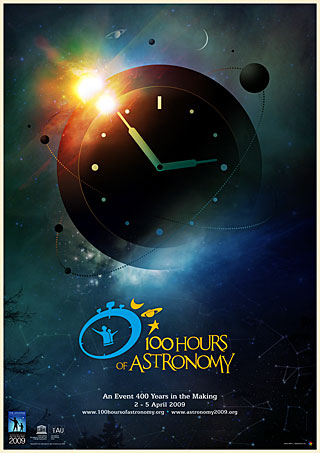
Tomorrow marks the beginning of 100 Hours of Astronomy, a worldwide event with millions anticipated to participate in astronomy activities round the clock. You can take part by finding your local events, but if you're from my two largest demographics, I'll save you some time:
1. The greater Santa Barbara area - the Santa Barbara Museum of Natural History and the Santa Barbara Astronomical Unit have teamed up once again to provide loads and loads of fun for people of all ages at a variety of venues. For more info, visit the AU's events link.
2. South Florida - you can find me and other members of the South Florida Amateur Astronomers Association at Fox Observatory in Markham Park.
If there are no events in your area (but I'd be surprised - astronomers are practically taking over the world this weekend!), you can participate remotely by tuning in to live webcasts from science centers around the world or by looking through telescopes with a streaming feed.
So get on board and take part, it's never been easier to get a little more astro-loving in your life. And bring your friends - they may not be as cool as you are, what with your Momstronomer buddy giving you the heads-up.
Thursday, February 5, 2009
Everyday Astronomy
One of this month's IYA themes is the solar system. And I'll bet you think that the topic doesn't have much to do with your everyday life. Unless you're an astrogeek like me, or you're unlucky enough to have a momstronomer like Little Dudestronomer. (Fortunately, he's too young to know that he's being submitted to torturous geekery every day of his life.) But even if you are not as nerdy as I am, I'm here to tell you that you and the solar system are closer than you think every single day.
Here is just one of the ways that the solar system affects your life. What day of the week is it? No matter what you answered, your response is something in our solar system. Give it a moment; I'll even give you a hint: can you think of any days that might be associated with the sun, the moon or Saturn?
[Waiting for your moment to pass...]
OK, so you have realized that Sunday is really Sun Day. Named after the sun. Monday is really Moon Day. And Saturday is Saturn Day.
This goes back to the Greeks, who named the days of the week after the sun, moon and five known planets (each of which were named after gods). The other days get a little trickier, because we have to trace them back to other languages. The first three are almost direct translations, but from here on out, we're going on an astrolinguistic journey. (I'm pretty sure that's not a real word.)
Tuesday comes from Tui - Tui's Day, which is the Germanicized version of the Norse god of war, Tyr. That Norse god can be traced back further to the Roman god of war, Mars. In fact, if you're a Spanish speaker*, you know that Tuesday in Spanish is martes, which is an even closer link. (Days of the week are not capitalized in Spanish.) If you're Greek, you'll be angry if I leave out the fact that the Romans' Mars was originally the Greeks' Ares.
Wednesday comes from Woden, the Ango-Saxon relative of the Norse God, Odin. Odin was the the counterpart of the Roman god Mercury (Hermes to the Greeks). Again, Spanish speakers might now see the connection with miércoles.
Thursday comes from Thor (Thor's Day). Thor is the Norse version of Jupiter, which is the Roman version of the Greek Zeus. For Spanish speakers, you will want to know that Jupiter has another Roman name, Jove.
Friday comes from Freya, the Norse goddess of love and beauty. Process of elimination will lead to know that the Roman goddess of love and beauty is Venus (Aphrodite to the Greeks).
So there you have it. Whether you knew it or not, you've been proudly displaying the solar system on your calendar. You probably plan events in your life around the planets; for example, you might watch American Idol on the day of Mars and the day of Mercury, but football is king on the day of the moon. You call your mom on the day of the sun, you go to yoga on the day of Jupiter and you TGI Venus.
*This goes for French and Latin as well, but interestingly not for Portuguese.
Thursday, January 29, 2009
Where Would You Point Hubble?
I remember working in the Space Lab at the Santa Barbara Museum of Natural History as an exhibit interpreter when I was a teenager. We had one exhibit labeled "Where Is Hubble Now?" People would always be really surprised to see that the display was a spherical model of Earth viewed from a bit out in space with a dot labeled "HST" near it. For some reason, far too many people think that the Hubble Space Telescope has actually traveled hundreds, thousands or even billions of lightyears through space to take the images it sends back to Earth. Of course you and I both know that's not true; HST is in low Earth orbit at a distance of 559 km above the earth.
HST takes great images because it's out of Earth's atmosphere. Trying to do astrophotography on the surface of the earth is like taking a picture from the bottom of a swimming pool; our turbulent atmosphere is always moving and flowing, which wreaks havoc on all those photons we're trying to capture. HST doesn't have that problem and, as a result, it takes some of the best images ever recorded of our universe.
If you were in charge of the Hubble Space Telescope for a day, where would you point it? NASA is giving you a chance to decide! In honor of IYA (see, I'm not the only one excited about it!), the folks at HubbleSite are offering us the people the chance to decide on what Hubble will study next. You can vote online here. If you're an educator, you can also register to receive a free Hubble Education Package. I won't tell you what I voted for, but I'll give you a hint: I voted for a "peculiar" target which gravity has distorted.
Tuesday, January 13, 2009
Sing Along Time
Did you know that IYA has its own theme song? Yes, it's true; the renowned science-popsters AstroCapella have penned a theme song, Shoulders of Giants. Little Dudestronomer and I have been rocking out to this number all morning. It's available for free download here, and is also the subject of the Astronomy Music Video Contest. That's right, you can make your own music video and enter to win a fabulous prize. First prize is $500 and a telescope, and categories include middle school, high school, graduate and artist (artist category is for original song and video). The deadline is January 7, 2010, so get cracking!
Thursday, January 1, 2009
By Way Of Introduction
Welcome to the Stay-At-Home Momstronomer! I'm your humble host, the aforementioned Momstronomer. You see, I spent 13 years working at a natural history museum teaching astronomy to people. Around year 12, I spawned a baby dudestronomer. A year later, my husband's schooling shuttled us away from my home-away-from-home, the Santa Barbara Museum of Natural History, and dropped us off in the foreign land of South Florida. One of the perks of this deal was that I went from full-time mom and full-time astronomy programs manager to extra-full-time mom.
It took me about 30 seconds to realize that even if no one was paying me for it, I couldn't say away from astronomy. Little Dudestronomer (as he shall henceforth be known on this blog) is a few days away from 18 months now, and he has no idea how ferociously I'm going to cram his noggin full of astrostuff. It's a tricky thing teaching these upper level concepts to little people (and to grown people as well), so I thought I'd share some of my tactics and experiences with you.
This is the right blog for you if you like astronomy, but don't know as much you'd like to about it. Also, if you know something about astronomy, but you're too lazy to follow all the headlines yourself, welcome aboard. Finally, if you find yourself in a similar situation to mine (you are charged with the education of young and fertile minds), please stay tuned.
One final word about IYA: 2009 is the official International Year of Astronomy. All over the world, people will be celebrating the 400th anniversary of Galileo's first use of the astronomical telescope with events and activities throughout the year. This blog is my contribution (as well as a lof of build-up work at my former place of employ, now taken over by my successor) to the cause. I will not be posting every day, but I will post regularly - a 2-3 times a week. My posts will not be novels; computer time is at a permium with the Little Dudestronomer in my care. So check back early and often for news, current sky events, activities and all the fun I can stuff into this blog.
Happy IYA!
Monday, October 27, 2008
Subscribe to:
Posts (Atom)


 Posts

