Saturday, December 1, 2012

Dreams Do Come True

I know that I've neglected my blog. It turns out that having three kids under the age of 6 keeps one pretty busy. Rest assured that I have been momstronoming plenty in my spare time, but it hasn't left much time for the blog. But that's not why I'm posting.
I'm posting to tell you that dreams really do come true. In 2004, I attended a lecture given by a friend who shared his experience travelling across the globe to see a total solar eclipse with his family, including 2 young children. At the end of his lecture, he strongly encouraged everyone to see a total solar eclipse sometime in their lives. Then he showed a map of all the total solar eclipses for the next 20 years. When I saw there would be an eclipse in Australia near the Great Barrier Reef in 2012, I knew I had found it. Hubbystronomer is a dedicated SCUBA diver and a love of all things marine. So I went home that night and pitched the idea. It was not a hard sell.
We came up with a plan. We started saving just a bit every month. $20 was all we could manage in those days; he was still in school, I had barely started working at my "real" job. But we had 8 years to make it happen. We started spreading the word to our family and friends, inviting them to also start planning and saving. As the years went by, we kept saving and planning and looking forward to November 2012.
Well, my friends, the day finally came. And we were ready. By then, the total number of our group had increased to 7. Of course Hubbystronomer and I were in; Little Dudestronomer was 5, Rarastronomer was 2 and half, and Babystronomer was 7 months old. My parents also came along.
That's right, I'm 100% mom and -stronomer. We packed more luggage than you would believe, schlepped it and our family across the world, and saw the moon eclipse the sun while sitting on the beach overlooking the Coral Sea. It was incredible. Everything I had hoped for. An experience we will truly never forget. We also snorkeled on the Great Barrier Reef, fed kangaroos, watched crocodiles attack, threw shrimp on the barbie, walked on amazing and exotic beaches in the South Pacific, and a few other amazing things I don't have time to share with you right now.
The moral of the story is: you can do it! You can create opportunities to share astronomy as a family, whether it's finding Jupiter in tonight's night sky or travelling across two continents to see a total solar eclipse. Get an idea, make a plan and don't let anything stop you.
In case you're in need of an idea and don't mind being taken for a momstronomer copycat, there will be a total solar eclipse here in the US in 2017. What are you waiting for? Start planning, people!


Monday, December 20, 2010

Lunar Eclipse Tonight!

This year's only lunar eclipse happens tonight, and is visible throughout North America. It starts at 10:33 PST (that's 1:33 AM Tuesday for those on the East Coast), with total eclipse at 12:17 AM PST (3:17 AM EST) and ending at 2:01 AM PST (5:01 EST). Just a reminder - this is a lunar eclipse, which means that Earth will move directly between the moon and the sun; Earth's shadow will fall on the moon, darkening it and, during totality, giving the moon an eerie reddish hue.
Would you like to know more about eclipses? Say so in the comments section and I will be glad to devote a new post to the topic.

Thursday, September 16, 2010

International Observe the Moon Night

Saturday August 18th is International Observe the Moon Night. With partnerships and sponsoring organizations all over the world, people everywhere will get the chance to observe the moon. For events near your area, click here. If you are in my area, come see me at Markham Park, where I'll be stationed with the South Florida Amateur Astronomers Association. We, like other groups around the world, will be showing people the moon through telescopes and talking about the moon, as well as offering hands-on activities for people of all ages. Hope to see you there!
For information about the event, visit the Observe the Moon website.

Saturday, August 21, 2010

Will Mars Appear As Big As The Moon?

In a word, no. Let me say that again: NO.

Every summer since 2003, an email has been circulating which claims that on the night of August 27th Mars will appear as big as the full moon. Of course, even the email itself admits, albeit in tiny print, that this will only be the case if Mars is view at 75-power magnification.

The truth is that in 2003, Mars and Earth were closer in their orbits than they had been in a long time, or will be in something like 60,000 years. That said, the difference between Mars' appearance in 2003 and, say, 2005 was extremely negligible.

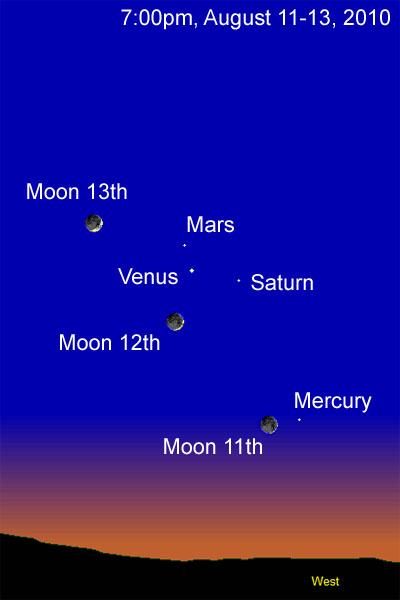
The good new? You can see Mars tonight in the night sky! In fact, if you time it right and the skies cooperate, you'll see Mercury, Saturn, Venus and Mars all once in the western sky at dusk. They'll all be gone by about 10 PM, so don't dally! (Oh, but also don't worry if it's overcast tonight; these planets will be all be visible together for the next week or so.)


Note: Even though you won't see the moon in those spots, since we're past those dates, you'll still the planets lined up like this through the end of the month. No telescope needed, so I don't want to hear any excuses!

On A More Personal Note...

I know I haven't posted in a while. I have good reasons, I promise. OK, one really good reason - our family's single "son" system went binary! I'm pleased to report that Little Dudestronomer is now a big brother to Baby Girlstronomer. I am going to try to keep things coming on the blog when I can, but things get more complicated in a binary system - ask any planet with more than one sun!

Sunday, June 28, 2009

How Do The Phases Of the Moon Work?

(This is hands-down the best moon phase activity I've ever done. In fact, when I first did this - after 10+ years as an astronomy educator - my mind was completely blown. This is one of my top 3 favorite astronomy activities, so I hope you enjoy it.)

If you've ever tried to replicate the phases of the moon, you probably did it the way I used to, by going into a darkened room, turning on a lamp in the middle of the room and then standing around it with a styrofoam ball in your hand. I'm here to tell you there's a better way.
Go outside! Yes, it's that simple. Take your ball on a stick and use the real sun! You see, the phases of the moon are really varying views of the shadow side and the sunny side of the moon as seen from Earth. It's so much easier to do than to explain that I'm just going to tell you how to do the activity and trust that it will all become clear to you. If not, just shoot me an email and I'll be sure to answer any questions you may have.

Here's what to do:

1. If you happen to have a small white styrofoam ball on hand, great! Prop it up on a stick, skewer, pencil or whatever you can find. If you don't, look for something similar. Ping pong balls are white, but a little on the small side. Little Dudestronomer has a small glow-in-the-dark basketball that I use for this purpose, and I just hold it with my hand because he insists I not pop it.
2. Go outside on a sunny day. This activity is most effective if you do it while the moon is out and visible, so check your times and dates and aim for a date/time when you can see the moon during the day.
3. As you hold your ball up in front of you, you can face toward or away from the sun, but the best starting place is off to the side of the sun a bit. As you look at your ball, you'll see that part of it is illuminated by the sun, and part is in shadow. You did it - you demonstrated one phase of the moon!
4. To get the whole cycle, imagine that you're Earth and your ball is the moon. Since the moon orbits Earth, make your ball orbit you - that is to say, spin in a circle with your arm outstretched. As you do, you'll see the phase of your little moon change. In order to get it to look right, you may need to tilt your orbit a bit.
5. If you have the real moon out in the sky, see if you can get your moon to look like the real moon. If it's a first quarter moon, make your moon first quarter. How long does the real moon take to get from first quarter to full? 1 week. From full to third quarter? Another week. From third quarter to new moon? Yet another week. And from new moon back to first quarter? You guessed it, one week.

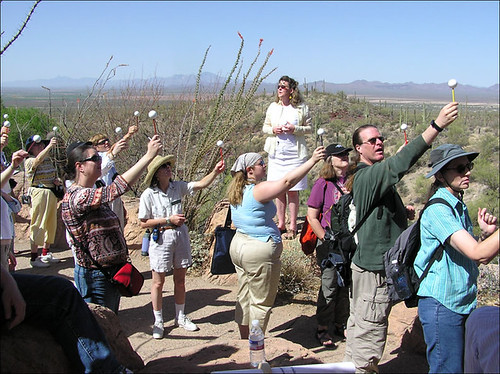
Here is an actual photograph from the first time I tried this activity with a group of educators through Astronomy From the Ground Up (though I'm not in the frame):

And to see if you're doing it right, your moon and the real moon should look like this (the real moon is to the right of the foam moon):

Wednesday, June 24, 2009

Kaguya Crashes

I'm a little behind the times on this one, but a couple of weeks ago, the Japanese spacecraft SELENE (nicknamed Kaguya) crashed into the lunar surface. This was a controlled collision that was complete after the orbiter successfully finished its 20-month mission studying the moon.
Kaguya orbited the moon elliptically, so that its oval-shaped path brought it closer and then farther from the lunar surface. Originally at a 100 km - 800 km orbital distance from the surface, it gradually got closer, first to a 50 km circular orbit, and then to a 20 km - 100 km elliptical orbit, eventually crashing into the moon.
The following is an image taken by Kaguya moments before it hit:

Saturday, June 20, 2009

Make Your Own Craters

While we're on the subject of lunar impactors, I feel the need to share a fun crater activity with you. This one is very easy and easily adaptable to just about any age audience. The supplies you will need include:

- a large pan or tub (a pie tin could work, as well as a baking pan, but don't use anything breakable)
- flour
- Nestle Nesquik, instant hot chocolate powder, cocoa powder or any other brown powder you can find
- pebbles, marbles, other spheres of varying sizes and masses

First, you'll put a layer of flour at the bottom of your pan. Make it at least half an inch thick, up to an inch if possible. Smooth out your flour. Next, put a thin layer of chocolate powder over the flour so that none of the chocolate shows. Finally, make your craters!
This is the part that you can adapt very easily. You can choose to use the same size/mass object and drop it into the powder from varying heights (or throw it at varying speeds, but dropping from different heights achieves the same result with better accuracy); or you can see what different objects dropped from the same height do. Try throwing your pebbles onto the tray at an angle.
As the objects impact the powder, the flour will come out from under, simulating the way subsurface materials are brought to the surface during an impact event. In addition, the contrast of the white flour and brown powder make it easy to see the impact sites and details.
There are a million variations on this one out there, but the Night Sky Network has a good one available online as part of a suite of activities for LCROSS; you can get the PDF here.

Friday, June 19, 2009

LCROSS (Finally) Launches

The Lunar Crater Observation and Sensing Satellite launched yesterday, after months of delays and with very little media attention. Originally scheduled to launch in October 2008, this mission will crash a 1,000 kg impactor into the moon at over 9,000 km/hr. Then it will fly through the debris and see what came up. (I love these missions that seem to have been conceived by ten year old boys!) The reason for doing this is to determine if there is any subsurface water on the moon, ostensibly to support any future lunar stations or settlements.
Also launching was the LRO, Lunar Reconnaissance Orbiter. With very high resolution imagers on board, LRO will take detailed 3-D images of the surface of the moon in order to identify possible future landing sites, and will even be on the lookout for any of the leftover Apollo equipment we left on the moon.
I'll keep you updated on further developments, and of course let you know when we start seeing 3-D lunar surface images.

Monday, June 15, 2009

June = Moon

June is going to be full of moon stuff, so here are highlights from Momstronomer:

-the launch of LCROSS (the Lunar Crater Observation and Sensing Satellite) with its companion satellite, LRO (the Lunar Reconnaissance Orbiter)

-the end of Kaguya, the Japanese lunar orbiter

-Not one, but two fun moon activities you can try at home

Stay tuned!

Tuesday, May 19, 2009

Earthrise

You may be familiar with the famous "Earthrise" image taken by Apollo 11 astronauts, in which they see Earth rising from the moon. Well, JAXA (the Japanese version of NASA) has their Kaguya spacecraft orbiting the moon right now, and they took a time lapse of Earth rising with their camera. I did not expect to be quite as moved by the sight of it as I was. Seeing our home world from this perspective is certainly unique. Please enjoy!

Monday, May 11, 2009

Atlantis Launches

I don't always post when the shuttle launches, but in this case I will. Because I was there! That's right; Hubbystronomer, Little Dudestronomer and I headed to Cape Canaveral to see the launch. How was it, you ask? Just as amazing as you imagined. It was really bright and shot up into the sky. It took a few seconds for the deep rumbling the reach us, and then it gave me heart palpitations.
It was so neat to see so many people out for the launch. There was a real spirit of camaraderie as we all waited, and people were even polite on the road afterward. That's the real sign of community.
Now the astronauts aboard will head to the Hubble Space Telescope for some repairs and replacements. It sounds simple, but this will be anything but. I'm sure there will be plenty of news coverage, so stay tuned.


Wednesday, May 6, 2009

Colbert Gets His Wish

As reported by NASA, Stephen Colbert will have his name on a piece of important space equipment. While it may not be a module of the International Space Station, it will be aboard ISS. Formerly known as T2, the Combined Operational Load-Bearing External Resistance Treadmill will provide astronauts will a much-needed exercise regime that will help keep them healthy in space. Way to go, COLBERT!

Friday, May 1, 2009

National Astronomy Day

I know I've been remiss in my posts of late, but I can't let today pass without reminding you that Saturday, May 2 is International Astronomy Day. Wherever you are, find an event and celebrate this exciting day with your loved ones. If you are in the Santa Barbara area, the Museum of Natural History will be hosting their annual festivities, including live science demos, make-and-take crafts for kids, lots of planetarium shows, a speaker from JPL to talk about a next-generation Mars robot, and a free telescope raffle.
I'll be at the Miami Science Center with Hubbystronomer and Little Dudestronomer. If you're in the area, I'll hope to see you there. If you're elsewhere, make sure to celebrate Astronomy Day!

Friday, April 10, 2009

The Sculptor Galaxy

Enjoy this lovely image, and please click to enjoy it even closer up!

Photo by Emanuele Colognato (copyright 2008, all rights reserved)

Wednesday, April 8, 2009

M33

Enjoy this photo of the spiral galaxy M33, taken by Charles Lillo in the Everglades. Click for biggination.

Image credit: Charles Lillo (copyright 2008, all rights reserved)

Monday, April 6, 2009

M81 and M82

Two, two, two galaxies in one (image, that is)! Click image for hugification.

Photo by Emanuele Colognato (Copyright 2009, all rights reserved)

Sunday, April 5, 2009

Galaxies Galore!

This month's IYA theme is galaxies, and I'm dying to talk with you more about that. However, I'm going to be out of town for the week. So I've prepared a few entries ahead of time to help you appreciate the best part of galaxies - looking at them! Special thanks to the talented photographers who let me use their images. They're all locals, in the South Florida Amateur Astronomical Association with me. See you next week!

Wednesday, April 1, 2009

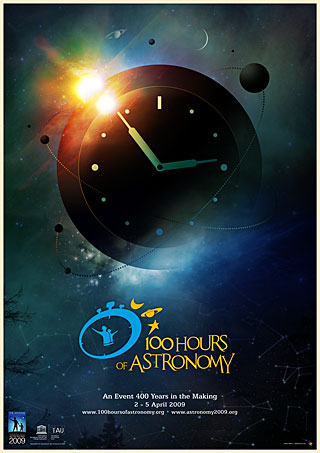
100 Hours of Astronomy

Tomorrow marks the beginning of 100 Hours of Astronomy, a worldwide event with millions anticipated to participate in astronomy activities round the clock. You can take part by finding your local events, but if you're from my two largest demographics, I'll save you some time:
1. The greater Santa Barbara area - the Santa Barbara Museum of Natural History and the Santa Barbara Astronomical Unit have teamed up once again to provide loads and loads of fun for people of all ages at a variety of venues. For more info, visit the AU's events link.
2. South Florida - you can find me and other members of the South Florida Amateur Astronomers Association at Fox Observatory in Markham Park.
If there are no events in your area (but I'd be surprised - astronomers are practically taking over the world this weekend!), you can participate remotely by tuning in to live webcasts from science centers around the world or by looking through telescopes with a streaming feed.
So get on board and take part, it's never been easier to get a little more astro-loving in your life. And bring your friends - they may not be as cool as you are, what with your Momstronomer buddy giving you the heads-up.

Saturday, March 28, 2009

News Round Up

At the top of this week's news is the safe return of Discovery earlier this evening. In other NASA news, it's not too late to vote for the name of the next Mars rover. After recent naming poll incidents, NASA has been clear that is a "non-binding poll." You can also send your name to Mars aboard that same spacecraft.


Universe Today announced this week its participation in "Live Telescope," which is pretty much what it sounds like. The Northern and Southern Galactic and Warren Rupp Observatory in Central Victoria, Australia, will broadcast a view through their telescope via webcast. At around 9:00 UT (which is nighttime there), they will start webcasting the view through their video eyepiece, and they won't stop until morning. Recent targets include the Jewel Box Cluster, Alpha Centauri, M11 and Alpha Crucis. You can tune in by visiting Universe Today.
And finally, to all the die hards out there (you know who you are!), I wish you a happy Messier Marathon! Too bad it's completely socked in here.